Skip to content

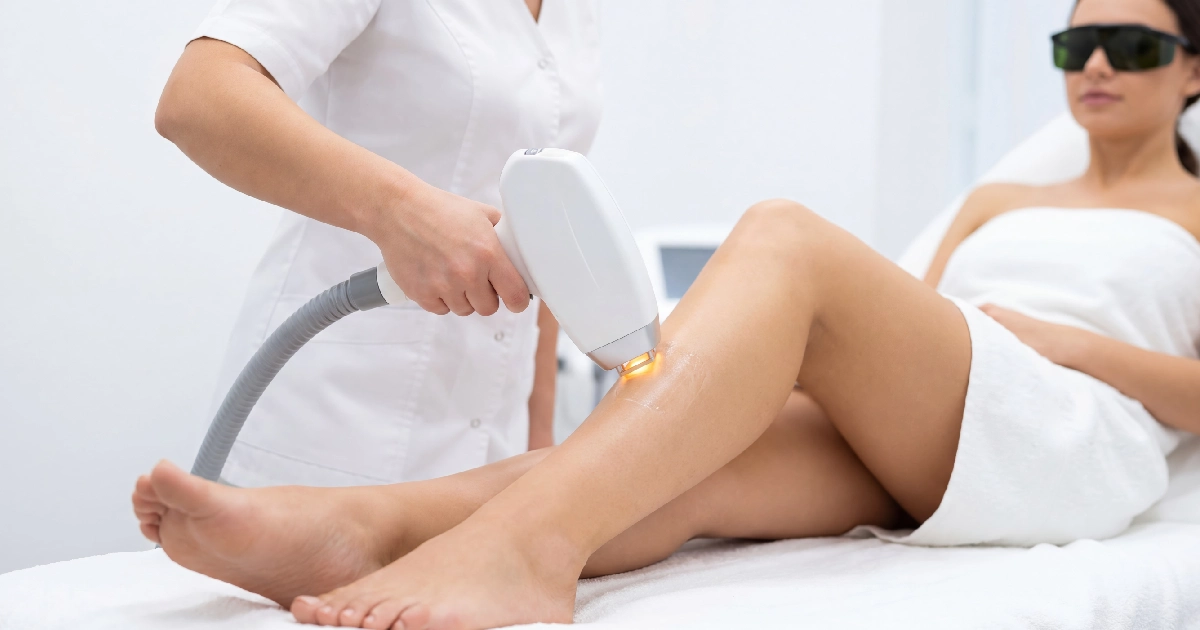
Table of Contents
If you have spent years shaving, waxing, and quietly wondering whether there is a better option, you are in very good company. Laser hair removal is one of the most requested treatments at Just Glam Aesthetics, and one of the most misunderstood. Many people book their first session without really knowing what the laser is doing beneath the skin.
What happens during a laser hair removal session?
Sessions are calmer than most first-timers expect. Shave the area about 24 hours ahead so the energy reaches the root instead of the surface hair. Your provider then glides the handpiece across the skin, & the DiolazeXL cooling tip we use for Hair Removal in Astoria, NY softens the quick, warm snap most people describe
What Laser Hair Removal Actually Does To The Hair Follicle
Laser hair removal treatment delivers light energy into the skin, where the pigment inside the hair absorbs it and converts it into heat. That heat damages the structures in the follicle that produce new hair.
The important part, and the part most beginners miss, is that the hair you see on the surface is not really the target. The root is. The laser passes through the outer layer of skin. It travels down the hair shaft to the follicle underneath, which is why unwanted hair removal with a laser behaves so differently from anything you do in the shower.
Clinicians call this selective photothermolysis, which sounds complicated but means something simple. The light is built to be absorbed by one specific thing, pigment, so the energy lands where it is needed & leaves the surrounding skin largely alone.
Why The Laser Targets Pigment And Not Skin
The treatment depends on contrast between the pigment in your hair and the pigment in your skin. The more the hair stands out from the surrounding skin, the more precisely the energy can be aimed at the follicle.
Three settings do most of the protective work here. Wavelength controls how deeply the light travels. Pulse duration controls how long the energy is delivered, so heat builds in the follicle rather than spreading. Cooling, usually built into the handpiece, keeps the skin’s surface comfortable while the follicle below absorbs the heat.
This is also why hair color matters so much. Dark hair holds plenty of pigment and responds best. Grey, white, red, and very fine blonde hair hold very little, so there is less for the light to find. That is a limitation of the physics, not a reflection of you or anything you have done.
Why You Need More Than One Session
One session is never enough, and the reason comes down to biology rather than technique. Hair does not grow all at once. Every follicle cycles through three phases:
- Anagen, the active growing phase
- Catagen, a short transition phase
- Telogen, the resting phase before the hair sheds
Only follicles in the active growing phase are firmly attached to their blood supply and full of pigment, so they respond best. At any given moment, only a portion of the hair in any area is in that phase. The rest is resting and essentially invisible to the laser.
That is why a hair reduction treatment is scheduled as a series rather than a single visit, with sessions spaced several weeks apart. Each appointment catches a different group of follicles as they rotate into active growth. Most people are looking at six to eight sessions spaced four to eight weeks apart.
Hair Reduction Versus Hair Removal: What The Results Really Mean
The honest term for what this treatment delivers is permanent hair reduction, not permanent removal, and understanding that difference will save you a lot of disappointment. The FDA defines permanent hair reduction as a stable, long-term reduction in the number of hairs regrowing, measured at six, nine, or twelve months after a treatment series.
In practical terms, that means the hair that does return is usually finer, lighter, and slower to come back than what you started with. Many people find that occasional maintenance sessions keep an area you want clear over time.
Results vary for real reasons: hair color and thickness, the area being treated, hormones, and how closely you follow the recommended schedule. One of the genuine laser hair removal benefits is that even partial reduction tends to cut down dramatically on ingrown hairs and the daily irritation that comes with shaving.
Who Laser Hair Removal Works Well For
Good candidacy depends more on your hair than your schedule. Darker, coarser hair gives the laser the contrast it needs, while very light or very fine hair doesn’t absorb enough energy to respond reliably.
Modern diode systems are designed to work across a wide range of skin tones on the Fitzpatrick scale, from very fair to very deep, by adjusting wavelength and cooling to the individual. Our provider at Just Glam Aesthetics assesses that in person rather than from a chart.
A few other factors matter too. Hormonal conditions such as PCOS can drive new hair growth even while existing follicles respond, and certain medications increase light sensitivity. None of these automatically rules you out. They just shape the plan, which is exactly why an in-person assessment beats any online quiz.
How Laser Hair Removal Compares To Shaving, Waxing, And Electrolysis
Shaving cuts hair at the surface & waxing pulls it from the root, but neither affects the follicle’s ability to produce more. Regrowth is built into both methods, which is why they never end.
Electrolysis takes a different route, treating one follicle at a time with an electrical current. It works on any hair color, including grey and blonde, but it is slow by design.
Laser hair reduction sits in between. Each pulse treats many follicles at once, which is what makes it practical for larger areas like legs, backs, and bikini lines.
Ready For Smoother Skin?
If you are tired of shaving and want smooth skin that lasts, Laser Hair Removal at Just Glam Aesthetics may be a good fit. Our team will walk you through candidacy, realistic expectations, and a schedule built around your hair and skin. Book Your Laser Hair Removal Session Today & let’s talk through it together.